Mow higher, mow smarter: the cheapest lawn fix
The one-third rule, the right height for cool-season grass, and why a sharp blade matters.
Mow higher, mow smarter: the cheapest lawn fix
Mowing is the practice you repeat most often, so small changes compound. The right height and a sharp blade do more for most lawns than another bag of fertilizer.
Start with height
Penn State's general guidance is 2 inches or above for most lawns, mowed regularly while the grass is growing. Within that range, match the height to the grass and the season.
- Tall fescue: Penn State lists 2.0 to 3.0 inches. Many lawns do better toward the higher end in summer heat or heavy traffic.
- Kentucky bluegrass: Penn State lists 1.5 to 2.5 inches. For a home lawn, staying near the top of that range is easier to manage.
- Fine fescue: a lower-maintenance choice for shade and dry sites, but do not scalp it.
The exact number matters less than consistency. A lawn cut at 3 inches every week is healthier than one cut at 2 inches, then 4 inches, then 2 inches again.
The one-third rule
Never remove more than one-third of the leaf blade in a single mowing. If the lawn is 4 inches tall and you want 3 inches, cut it now. If it is 6 inches tall, do not cut it to 3 in one pass; take it down in stages.
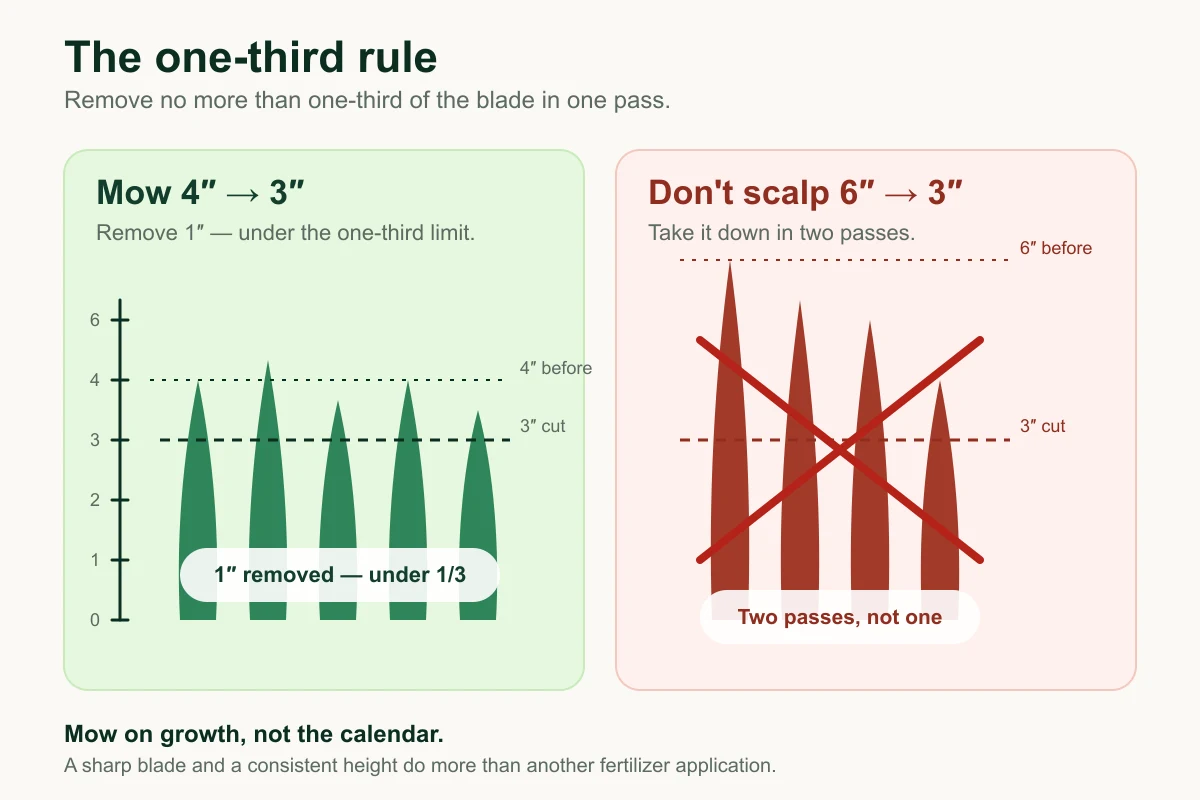 The one-third rule: 4″ to 3″ removes 1″, which is under one-third. Cutting 6″ to 3″ in one pass removes half the blade. Tap to enlarge. TurfLab diagram.
Penn State's establishment guidance uses the same idea: begin mowing when the grass is about one-third taller than the desired height. If you want a 3 inch lawn, start mowing before it reaches 4 inches.
Mow on growth, not the calendar
Frequency should follow growth, not a fixed day of the week. In spring, cool-season grass can grow fast enough to need mowing more than once a week. In a dry summer, it may slow down and need less. In fall, it picks up again.
Do not mow wet grass. It tears, clumps, and can leave ruts in soft soil. Wait until the surface is dry.
Keep the blade sharp
A dull blade tears the leaf instead of cutting it. Torn tips lose more water, look ragged, and can invite disease. Sharpen the blade regularly, and check the deck and oil while you are at it.
Leave the clippings
If you are mowing often enough that clippings are small, leave them. They return nitrogen and organic matter. Bag them when they clump, when the lawn is wet, or when disease is a concern.
Mow high for weeds, but do not stop there
A taller canopy shades the soil surface and helps keep weed seeds from getting the light they need. That is one reason mowing high is part of a crabgrass plan. It is not a replacement for pre-emergent timing or a dense lawn.
If you are dealing with crabgrass, goosegrass, or quackgrass, read the identification guide before you buy anything.
A simple mowing routine
- Set the deck at the right height for the grass and season.
- Mow when the lawn is dry.
- Remove no more than one-third of the blade.
- Alternate the direction each mowing to avoid ruts and matting.
- Leave clippings when they are small.
- Sharpen the blade regularly.
- Raise the deck, not the fertilizer rate, when the lawn is stressed.
Sources
- Lawn Management through the Seasons — Penn State Extension
- Turfgrass Species for Pennsylvania — Penn State Extension
- Lawn Establishment — Penn State Extension
Sources support the general guidance; product labels and local law control any application. See our terms.