Crabgrass, goosegrass, or quackgrass? Identify before you spray
Three grassy weeds that look similar but need different plans. Check the stem, seedhead, and life cycle first.
Crabgrass, goosegrass, or quackgrass? Identify before you spray
Grassy weeds are hard because the leaves look like grass. The useful differences are in the stem, the seedhead, and whether the plant comes back from roots or seed.
Get the identification wrong, and the plan is wrong: a pre-emergent does nothing for an established perennial, and a nonselective herbicide will take the lawn with the weed.
Quick comparison
Swipe to compare →
| Feature | Crabgrass | Goosegrass | Quackgrass |
|---|---|---|---|
| Life cycle | Summer annual | Summer annual | Perennial |
| Growth habit | Spreads out, light green, coarse | Flattened, prostrate, often silvery at the center | Upright, spreads by rhizomes |
| Stem | Rounder, often rooting at nodes | Whitish, flattened, tough | Clasping auricles at the base |
| Seedhead | Finger-like spikes | Two to five racemes in a herringbone pattern | Spike-like seedhead |
| Main timing | Germinates around 55°F soil temperature | Germinates later than crabgrass | Existing plants persist year to year |
| Plan | Prevent before germination; remove small plants | Prevent; fix compaction | Renovation; pre-emergent will not kill it |
Crabgrass
Crabgrass is a summer annual. It germinates from seed in spring, grows through summer, sets seed, and dies at frost. It is usually lighter green and coarser than the lawn around it, with a fibrous root system and stems that can root at the nodes.
The seedhead is the giveaway: finger-like spikes that radiate from a central point. In Pennsylvania, crabgrass germination is commonly tied to soil temperatures around 55°F for several days. That is why the soil temperature tool is more useful than a date on the calendar.
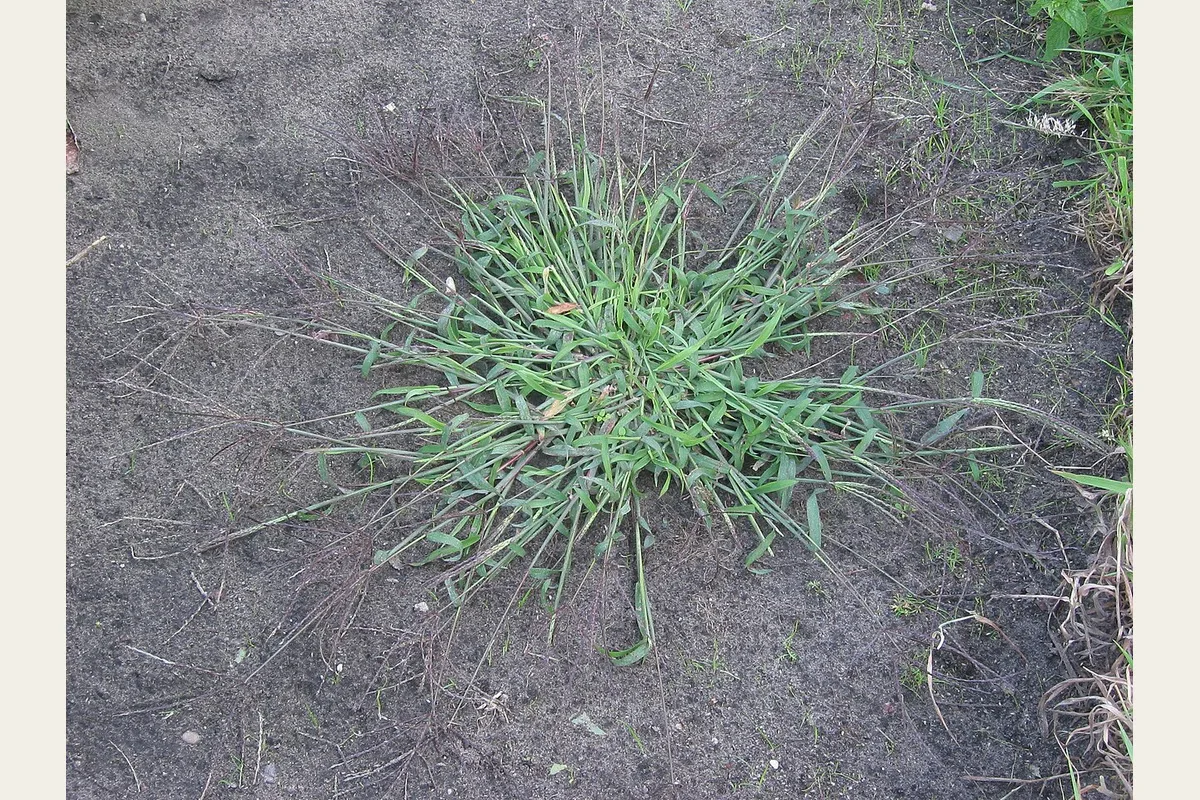 Crabgrass (Digitaria sanguinalis) in bare soil. The plant is light green, coarse, and spreads outward. Photo: Rasbak / Wikimedia Commons, CC BY-SA 3.0.
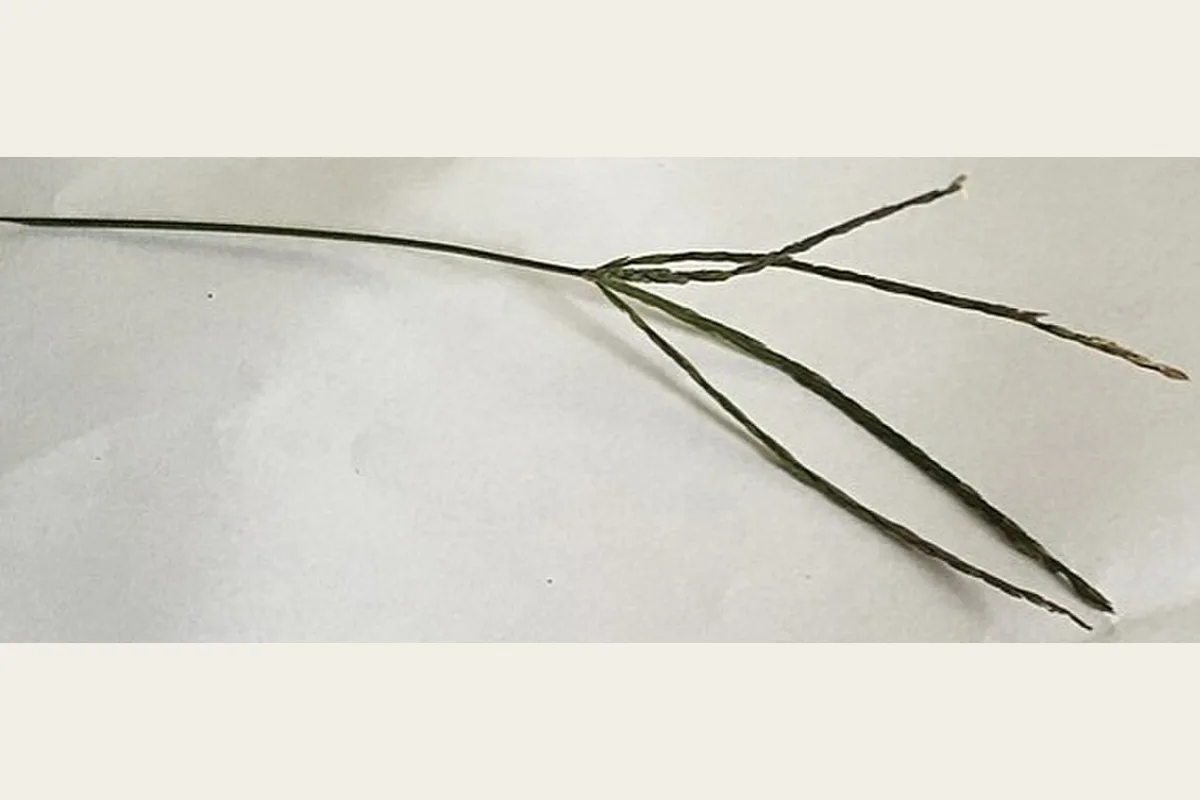 Crabgrass seedhead: finger-like spikes radiate from a central point. Photo: Prahlad balaji / Wikimedia Commons, CC BY-SA 4.0.
What works:
- Prevent it before germination with a product labeled for your grass and the site.
- If you are overseeding, check the seeding interval on the pre-emergent label first. The overseeding planner can help you sequence the work.
- Pull small plants before they set seed. Crabgrass is an annual; stopping seed production matters.
- Fix thin turf. A dense canopy is the long-term control.
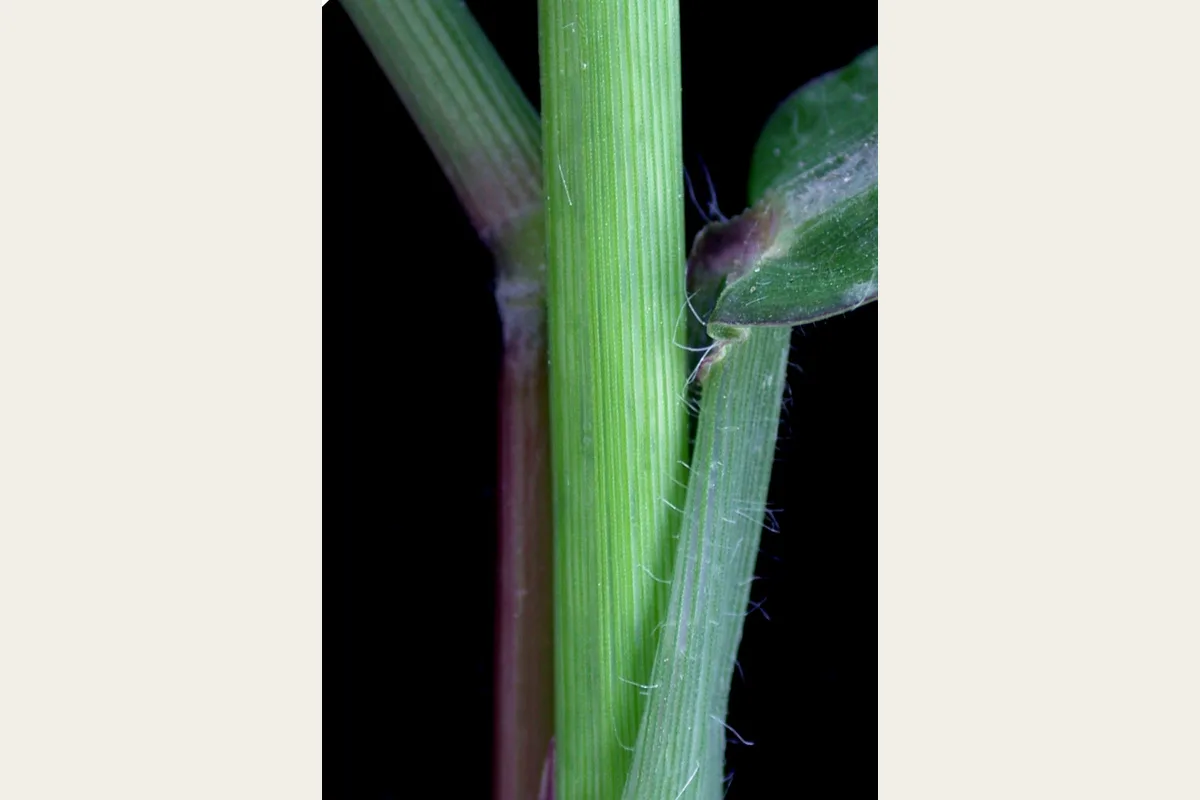 Crabgrass leaf collar and sheath. The ligule is membranous, and the plant lacks the clasping auricles of quackgrass. Photo: Gilles Ayotte / Wikimedia Commons, CC BY-SA 4.0.
What does not work: a broadleaf herbicide. Crabgrass is a grass, not a broadleaf weed.
Goosegrass
Goosegrass is also a summer annual, but it behaves differently. It is often darker green, flatter, and more prostrate than crabgrass. The center of the plant can look whitish or silvery, and the stem is flattened and tough.
The seedhead usually has two to five racemes arranged in a herringbone pattern. At the leaf base, goosegrass has a membranous, jagged ligule divided in the center and no auricles. Those are hand-lens details, but they are reliable.
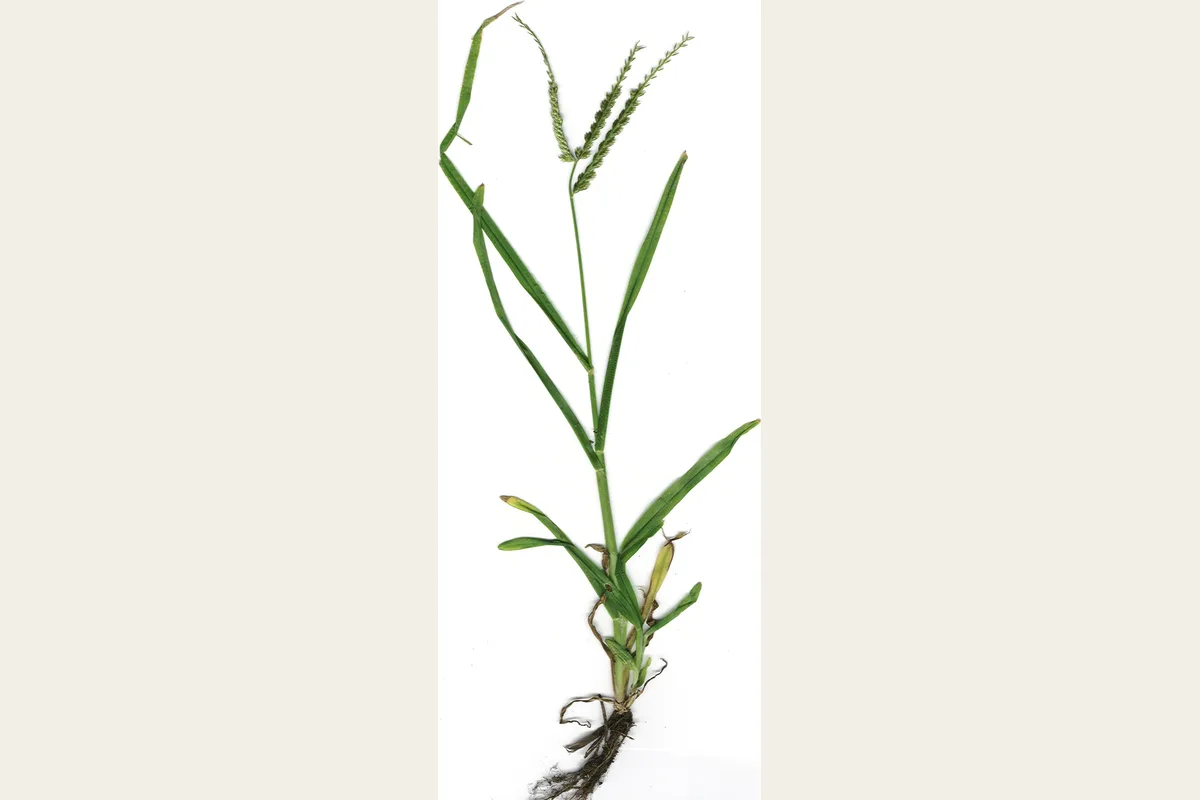 Goosegrass (Eleusine indica) plant. The stems are flattened and the plant grows prostrate. Photo: Forest & Kim Starr / Wikimedia Commons, CC BY 3.0.
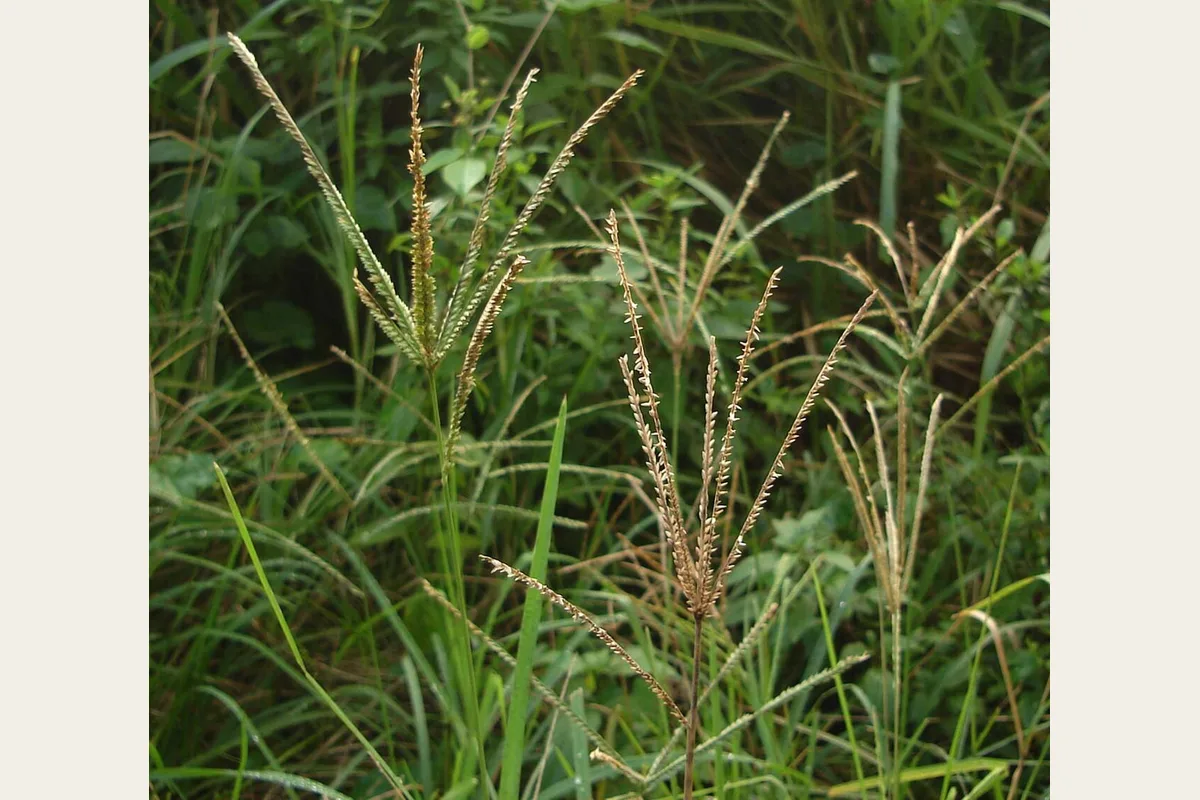 Goosegrass seedheads: two to five racemes in a herringbone pattern. Photo: Tauʻolunga / Wikimedia Commons, CC BY-SA 3.0.
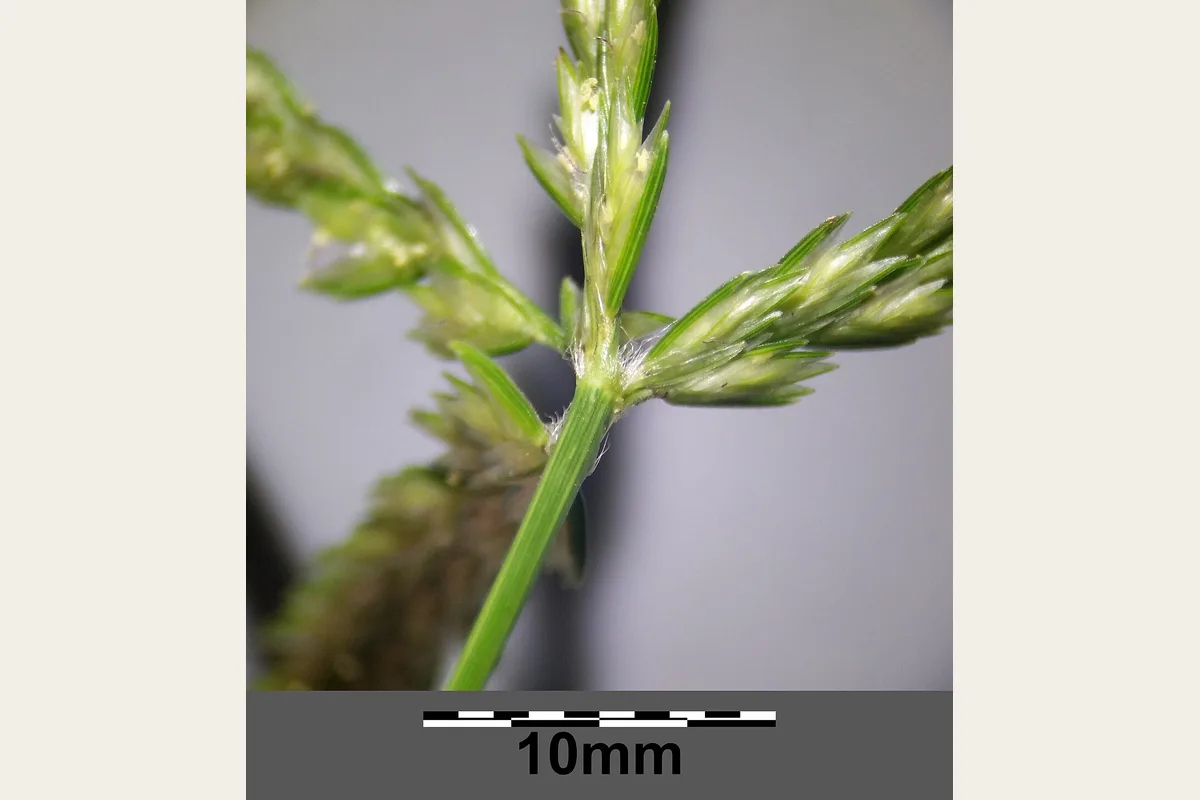 Goosegrass stem and seedhead. The whitish, flattened stem is a useful field mark. Photo: Stefan.lefnaer / Wikimedia Commons, CC BY-SA 4.0.
Goosegrass likes compacted, high-traffic, poorly drained areas. It also germinates later than crabgrass, often when the soil is warmer. That later timing is why one early pre-emergent application may not be enough in a bad year, and why the label and local guidance matter.
What works:
- Correct the compaction and drainage that favor it.
- Use a pre-emergent program labeled for goosegrass, timed to its germination window.
- Keep the lawn dense and mowed at the right height.
- Remove small plants before they set seed.
Quackgrass
Quackgrass is a perennial cool-season grass. It spreads by rhizomes and also by seed. It does not behave like a summer annual, so a pre-emergent is not the answer for plants that are already there.
Look for clasping auricles at the base of the leaf blade and a rhizome system that keeps coming back. The seedhead is spike-like. It can blend into a cool-season lawn until it forms a patch.
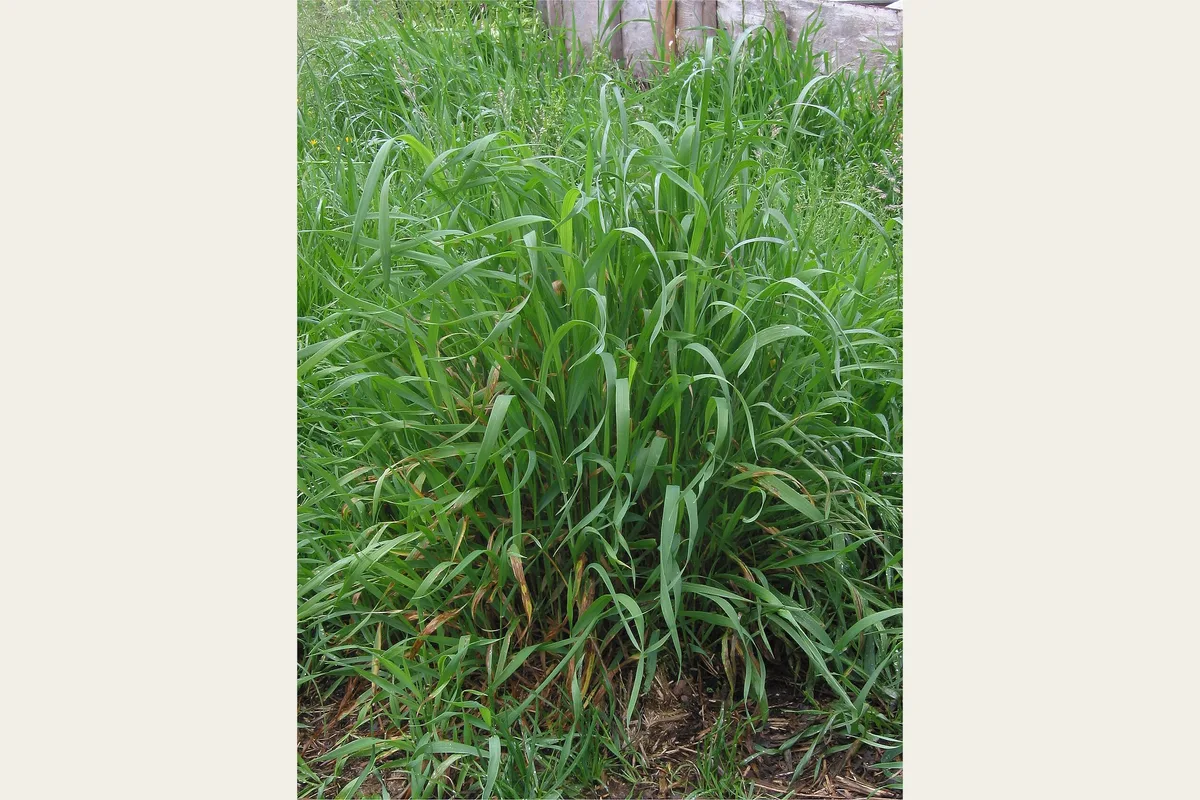 Quackgrass patch in a lawn. It spreads by rhizomes and can blend into cool-season turf. Photo: Rasbak / Wikimedia Commons, CC BY-SA 3.0.
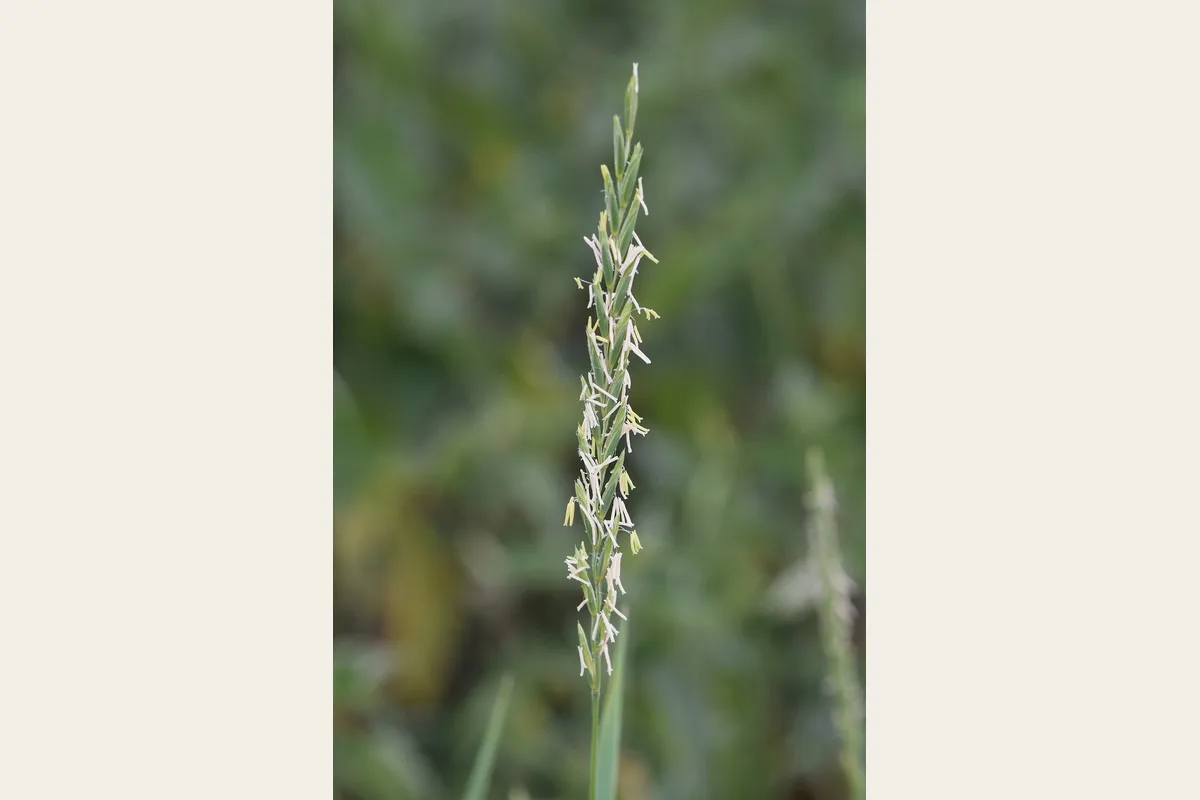 Quackgrass seedhead: a spike-like arrangement. Photo: Krzysztof Ziarnek, Kenraiz / Wikimedia Commons, CC BY-SA 4.0.
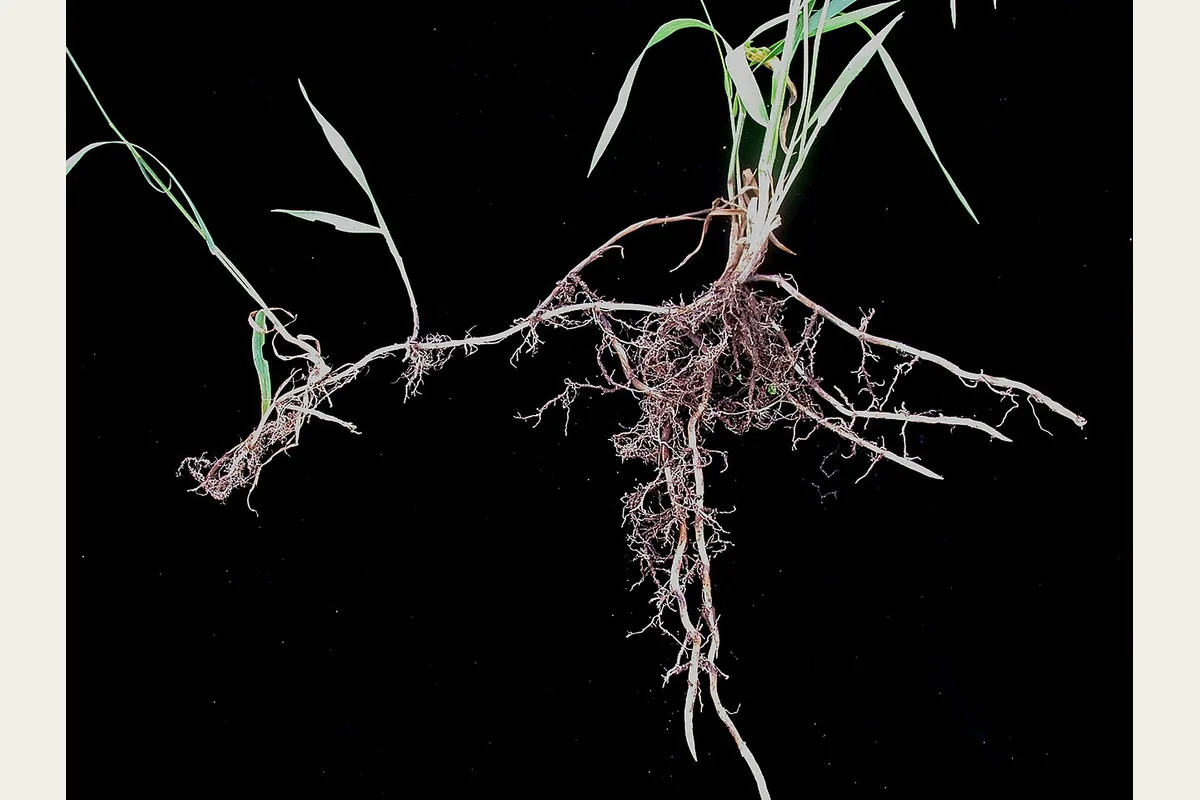 Quackgrass rhizome and roots. The rhizomes are why the plant keeps coming back. Photo: Gilles Ayotte / Wikimedia Commons, CC BY-SA 4.0.
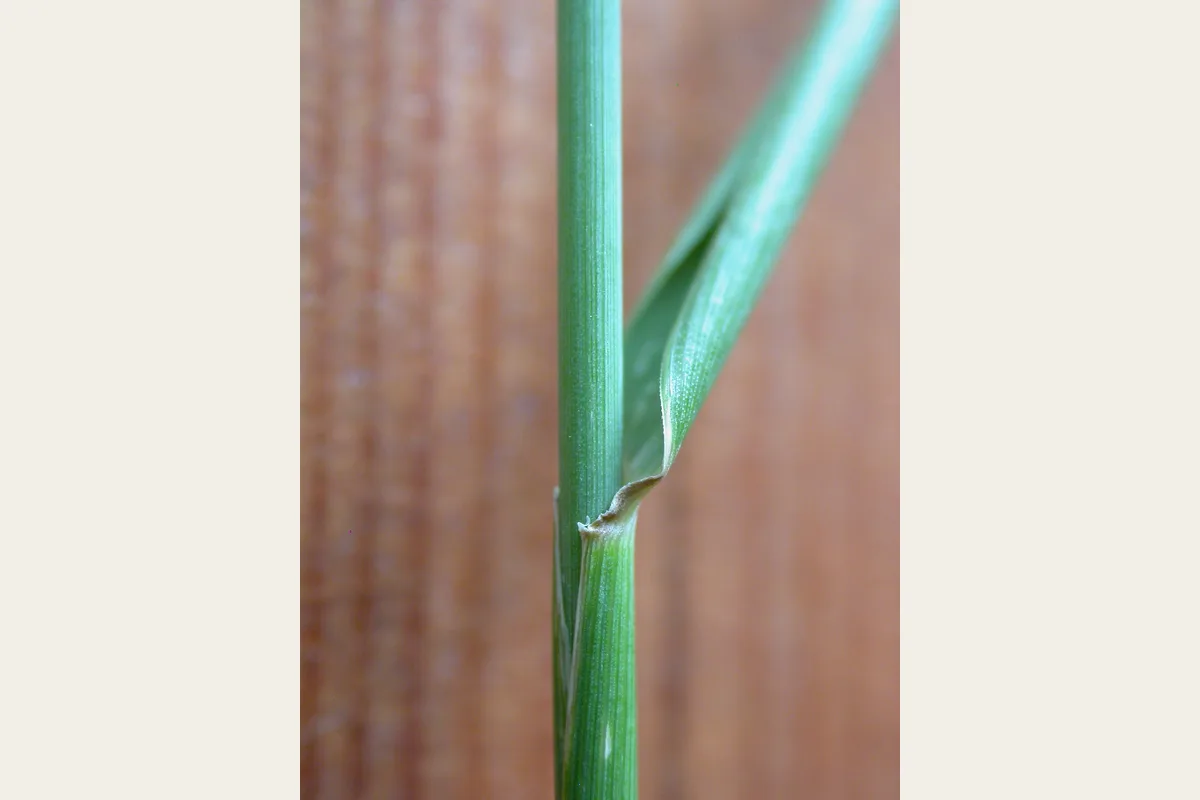 Quackgrass auricle: the clasping, claw-like base is a key identification feature. Photo: Matt Lavin / Wikimedia Commons, CC BY-SA 2.0.
What works:
- Do not let it spread. Mow before seed set and clean equipment.
- In cool-season turf, selective control is limited. The practical options are repeated removal or a nonselective herbicide followed by reseeding, depending on the site.
- If you renovate, use a product labeled for the job, follow the waiting interval, and establish the new lawn properly.
- Improve the turf around it so the patch has competition.
What does not work: assuming a "weed and feed" will fix it. Quackgrass is a grass, and the product has to be labeled for both the weed and your lawn.
The bigger fix
All three weeds exploit thin turf. The durable plan is the same:
- Test the soil and fix real nutrient problems.
- Mow at the right height for the grass.
- Water deeply and infrequently rather than daily.
- Aerate compacted areas when the soil is moist, not muddy.
- Overseed at the right time with a cultivar or blend that fits the site.
The Pennsylvania lawn-care calendar is the starting point. The fertilizer guide explains how to feed the lawn without overdoing it.
Image credits
- Crabgrass whole plant: Rasbak, Wikimedia Commons, CC BY-SA 3.0.
- Crabgrass seedhead: Prahlad balaji, Wikimedia Commons, CC BY-SA 4.0.
- Crabgrass collar: Gilles Ayotte, Wikimedia Commons, CC BY-SA 4.0.
- Goosegrass whole plant: Forest & Kim Starr, Wikimedia Commons, CC BY 3.0.
- Goosegrass seedheads: Tauʻolunga, Wikimedia Commons, CC BY-SA 3.0.
- Goosegrass stem: Stefan.lefnaer, Wikimedia Commons, CC BY-SA 4.0.
- Quackgrass patch: Rasbak, Wikimedia Commons, CC BY-SA 3.0.
- Quackgrass seedhead: Krzysztof Ziarnek, Kenraiz, Wikimedia Commons, CC BY-SA 4.0.
- Quackgrass rhizome: Gilles Ayotte, Wikimedia Commons, CC BY-SA 4.0.
- Quackgrass auricle: Matt Lavin, Wikimedia Commons, CC BY-SA 2.0.


Sources
- Lawn and Turfgrass Weeds: Smooth Crabgrass and Large Crabgrass — Penn State Extension
- Lawn and Turfgrass Weeds: Goosegrass — Penn State Extension
- Orchardgrass and Quackgrass — Penn State Extension
- Weed Management in Turf — Penn State Extension
- Crabgrass and Goosegrass Identification and Control in Cool-Season Turfgrass for Professionals — Rutgers Cooperative Extension
- Lawn Management through the Seasons — Penn State Extension
Sources support the general guidance; product labels and local law control any application. See our terms.