How to read a fertilizer bag without overdoing it
N-P-K, slow-release nitrogen, and Pennsylvania application limits, explained with the math.
How to read a fertilizer bag without overdoing it
Fertilizer is not a vote for a greener lawn. It is a nutrient delivery tool, and the label is the instruction sheet. Once you can read the three numbers and do one calculation, most of the confusing bags in the aisle sort themselves out.
The three numbers are percentages
A bag marked 20-0-10 contains:
- 20% nitrogen (N) by weight
- 0% phosphate (P₂O₅)
- 10% potash (K₂O)
The P and K numbers are expressed as oxides, not elemental phosphorus and potassium. That is a labeling convention, not a marketing trick.
A 50 lb bag of 20-0-10 contains 10 lb of nitrogen (50 × 0.20). The rest is carrier, filler, and other nutrients. The bag might also contain iron, sulfur, or a pre-emergent. Read the fine print.
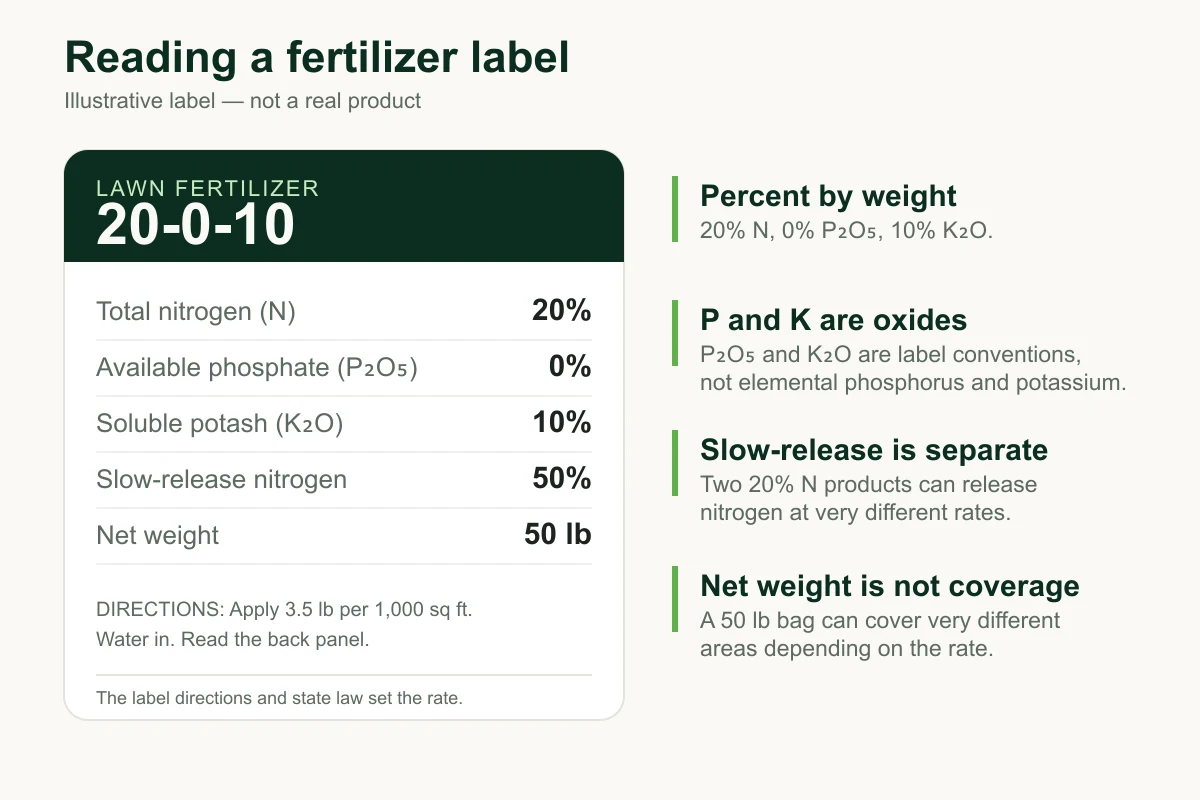 An illustrative label, not a real product. The three numbers are percentages by weight; P and K are reported as oxides. Tap to enlarge. TurfLab diagram.
What each nutrient does
- Nitrogen drives shoot growth and color. It is the nutrient most likely to be overapplied, and it can leach or run off.
- Phosphorus supports roots and establishment, but established lawns often have enough. Do not add it without a soil test.
- Potassium supports stress tolerance, but a soil test is the only way to know whether you need it.
Penn State's guidance is blunt: the only way to know how much phosphate and potash your turf needs is a soil test. Nitrogen cannot be measured by a routine soil test, so nitrogen decisions come from the lawn's growth, the product label, and local rules.
The only calculation you need
To apply a target amount of nitrogen per 1,000 sq ft:
pounds of product = target lb N ÷ (N% ÷ 100)
Example: you want 0.7 lb N per 1,000 sq ft and the bag is 20-0-10.
0.7 ÷ 0.20 = 3.5 lb of product per 1,000 sq ft
If your lawn is 4,000 sq ft, multiply by 4: 14 lb of product. That is less than a third of a 50 lb bag. This is why "apply a bag per 5,000 sq ft" can be wrong for your lawn.
Use the fertilizer calculator to do the math for your lawn size and bag.
Slow-release is not a marketing word
Nitrogen comes in different forms. Some release quickly; some are coated or reacted to release more slowly. A bag with a high percentage of water-soluble nitrogen can green up fast, but it also has a higher burn and runoff risk if you apply too much or water it incorrectly.
Look for the slow-release nitrogen statement on the label. It may say "X% slow-release nitrogen" or name the technology. Follow the label's rate and watering instructions. More nitrogen is not better; it is a liability.
Pennsylvania's limits
Pennsylvania's fertilizer law applies to homeowners, not just lawn companies. The exact requirements are on the product label and the Pennsylvania Department of Agriculture's page, but the key limits for turf are:
- 0.7 lb of plant-available nitrogen per 1,000 sq ft per application
- 0.9 lb of total nitrogen per 1,000 sq ft per application, unless the product is an enhanced-efficiency nitrogen fertilizer
- No phosphate on established turf unless you are establishing, reestablishing, or repairing the turf, or using an enhanced-efficiency phosphorus product
- For enhanced-efficiency phosphorus, natural organic, or organic-based products, no more than 0.25 lb per 1,000 sq ft per application and 0.5 lb per 1,000 sq ft per year
- Keep a 15-foot buffer from lakes, ponds, wetlands, and flowing water
- Do not apply near storm drains or ditches, before heavy rain, to frozen or snow-covered ground, or onto hard surfaces
Those limits are per application. They are not a target. A soil test and the label decide the rest.
The law distinguishes plant-available nitrogen from total nitrogen. If the bag lists both, do not mix them up. When in doubt, use the lower rate and the label.
A practical sequence
- Measure the lawn. Use the lawn size calculator or a measuring wheel.
- Soil test first if you have not done one. Read Soil test before fertilizing.
- Choose a product that fits the nutrient need, not the biggest bag.
- Calculate the product weight for your lawn and target rate.
- Calibrate the spreader. Guessing the setting is how lawns get stripes and burn.
- Apply evenly, sweep hard surfaces, and water in if the label says so.
- Record what you applied. The dashboard treatment history is there for this.
What about weed and feed?
A weed-and-feed product combines fertilizer with an herbicide. That can be useful when the timing for both jobs matches, but it is a bad way to solve a weed problem on a calendar. The herbicide may not be labeled for your grass, the fertilizer rate may be wrong for your lawn, and the timing may be wrong for the weed. Treat the weed problem on its own schedule.
The bottom line
The bag is not a recommendation. It is a label with a rate, a nutrient analysis, and legal limits. Read it, do the division, and apply less than you think you need. The lawn will tell you whether the plan is working.
Sources
- Homeowners and Applicators — Pennsylvania Department of Agriculture
- Lawn Management through the Seasons — Penn State Extension
- Turfgrass Fertilization: A Basic Guide for Professional Turfgrass Managers — Penn State Extension
Sources support the general guidance; product labels and local law control any application. See our terms.